
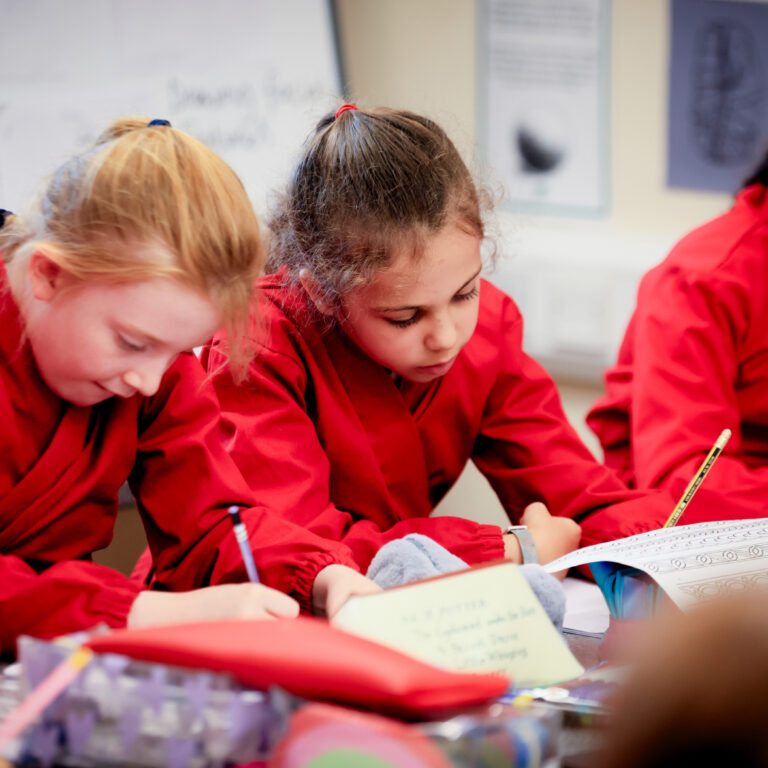
“Small class sizes” appears on almost every independent school website in Hertfordshire. It is worth asking two things of any school that says it: what is the actual number, and what do you do with it? At St Hilda’s in Harpenden, a typical class is around 18 pupils. The ambition attached to those small classes is anything but small.
What a class of 18 looks like from the inside
- A typical class size of around 18 pupils, from Reception to Form VI
- Girls from age two to eleven on a single town-centre site, so staff know children for nine years, not one
- Specialist teaching in music, PE, art, drama, languages and computing
- Setting and specialist teaching in Maths, English and Reasoning from Form V
- Thirty-five clubs a week and wraparound care from 7:30am to 6pm
Small classes change how teachers teach
The point of a small class is not a quieter room. It is that a teacher can plan for individuals instead of for a middle.
- Misconceptions are caught during the lesson rather than in that evening’s marking
- Every child reads aloud, answers and contributes every day; there is nowhere to hide, and no need to
- Pre-learning groups prepare children before a topic; booster groups consolidate afterwards
- Individual Education Plans and termly target-setting for pupils who need closer monitoring
- Support delivered in class, in small groups or 1:1, depending on what the child needs that term
Our learning support team works with external speech therapists, occupational therapists and educational psychologists where it helps, and meets parents termly to review targets.
Ambition is stretched, not assumed
St Hilda’s takes a mixed-ability intake and holds a reputation for high academic standards, those two things sit together because of the class size, not in spite of it. Phonics starts in Nursery and children are reading early. Entrance exam preparation begins in Form IV. By Form V, girls are set for Maths, English and Reasoning with specialist teachers. You can follow the journey through our Pre-Prep and Prep pages.
A small school does not mean a small week
- Sport: netball, football, tennis, gymnastics, dance, fencing, table tennis, skiing and a summer athletics, rounders and cricket club, coached by qualified professionals; see sport at St Hilda’s
- Music: one-to-one lessons in piano, voice, strings, woodwind, brass, drums and guitar, plus two choirs, orchestra, wind band, string group, Showtime Singers and a House Music Competition
- Drama and art: LAMDA, two art clubs, class concerts and full school productions
- Wider learning: STEM Club, German Club, Authorfy writing club and Silver Stories readers
- Outdoors: Outdoor Explorers woodland sessions every term for every year group
The full weekly list is on our extra-curricular activities page.
The proof is in where the girls go
Over the past six years, St Hilda’s leavers have gone on to 23 different senior schools, among them STAHS, Berkhamsted, Queenswood, Abbot’s Hill and St George’s, and have won 70 scholarships and awards across academic, sport, art, drama and music. Every family meets the Headmaster in Year 5 to plan the move, and an annual Secondary Transfer Fayre brings senior school staff into the building. The figures are set out on our destination schools page.
Small school, whole child
Ambition without wellbeing is fragile, so the two are managed together: Form VI mentors paired with younger girls, Wellbeing Captains in every house, and six values, positivity, independence, courage, respect, kindness and resilience, that pupils helped to write. Our most recent Independent Schools Inspectorate inspection in February 2024 found that all standards were met; under the previous framework, the 2019 inspection judged the school excellent in every area. Both reports are on our inspections page, and there is more on pastoral care under wellbeing.
Come and see a small class in action
Numbers on a website only go so far. Book a personal tour and see a class of 18 during a normal lesson, or join one of our open events in Harpenden.