
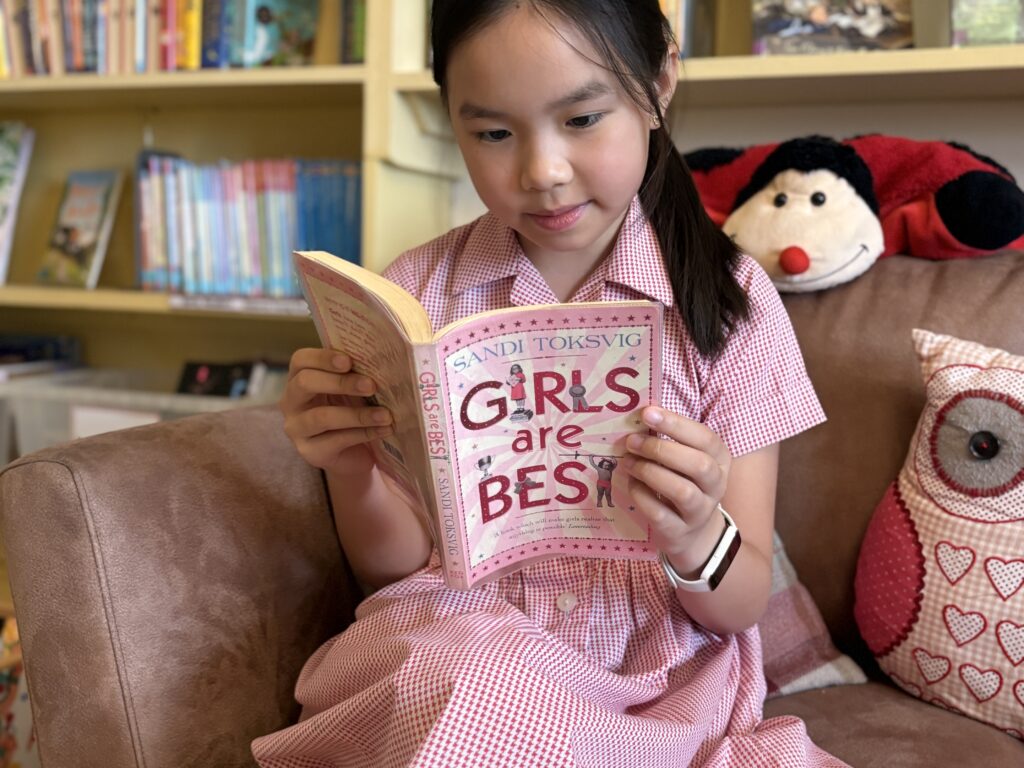
Yesterday was Roald Dahl Day; marked every year on 13 September, the author’s birthday. It is a date that always feels at home here. Dahl wrote for children who suspected that words could be mischievous, and that is exactly the spirit we want in a classroom: girls who pick up a book because they cannot wait to find out what happens next, not because someone has told them to.
A love of reading is one of the few things that shapes every other part of a child’s education. It widens vocabulary, steadies concentration, and quietly builds the confidence to tackle an unfamiliar word, an unfamiliar idea, or an unfamiliar room full of people. Here is how we grow that habit at our prep school in Harpenden.
Reading is taught, but it is also caught
Structured teaching matters. Girls need phonics, comprehension and the technical skill to decode a page, and those are taught deliberately from the Early Years upwards as part of our curriculum. But the part that lasts is caught rather than taught: it comes from adults who talk about books with real enthusiasm, and from being handed the right story at the right moment.
That is where small classes earn their keep. When a teacher knows every girl in the room, she knows which one has stalled halfway through a series, which one is ready for something harder, and which one needs a funny book rather than an improving one. It is a small advantage repeated daily, and it compounds.
What a reading-rich classroom looks like
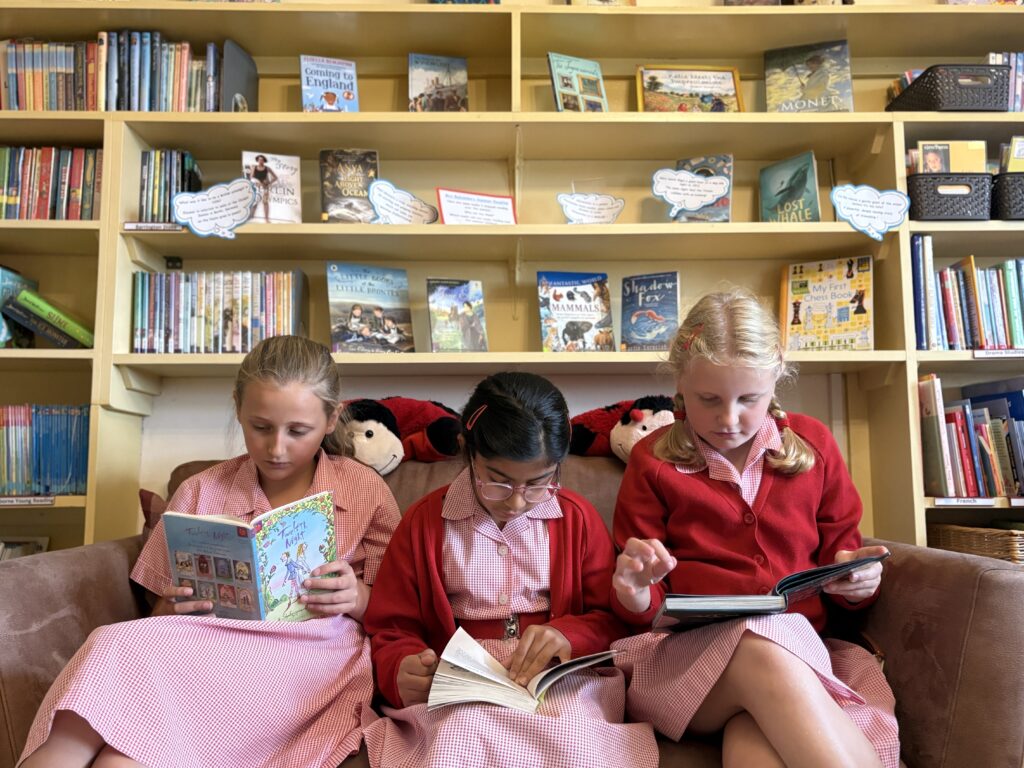
Across Pre-Prep and Prep, reading runs through the week rather than sitting in a single slot on the timetable:
- Daily reading time, so that picking up a book becomes ordinary rather than an event
- Stories read aloud by staff, including books slightly beyond what girls could yet manage alone
- Reading across subjects, from history sources to instructions in a science investigation
- Tailored support where a girl needs it, so that no one quietly falls out of love with reading because it feels hard
- Book-led moments in the wider life of the school, from author days to clubs and performances
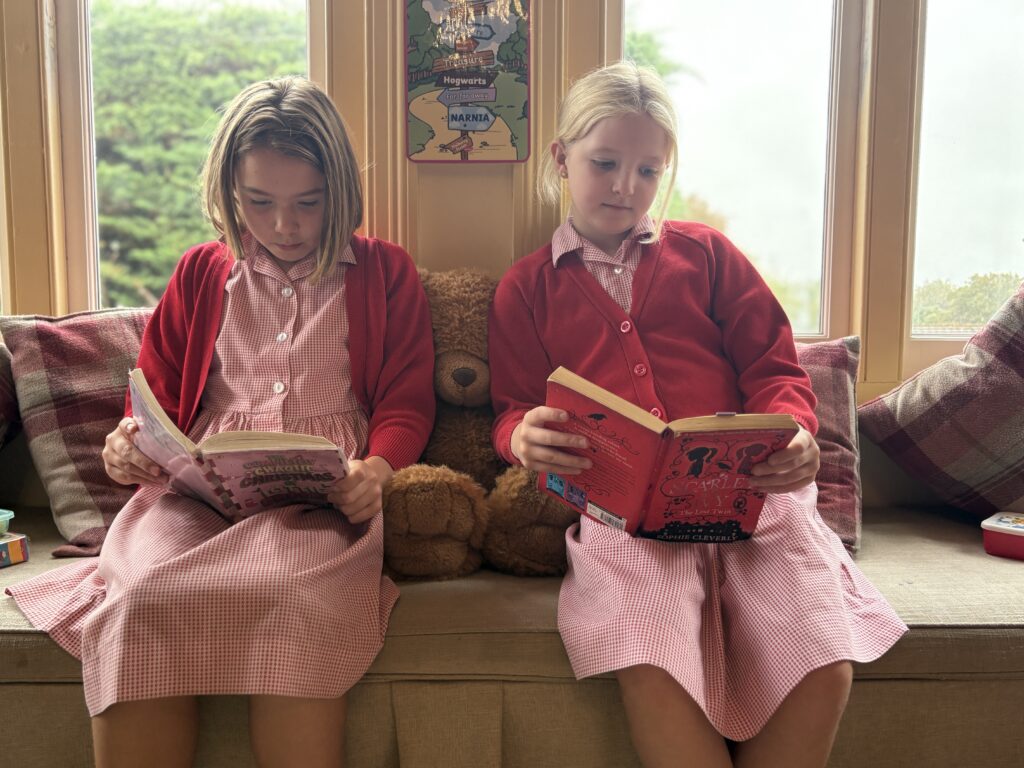
Why Roald Dahl still earns his place on the shelf
Dahl is often a child’s first taste of an author with a voice — the invented words, the relish for the ridiculous, the adults who are entirely beatable. Read Matilda or The BFG at seven or eight and you learn something useful: that a book can be yours, that it can be funny, and that the person who wrote it was enjoying themselves.
We use days like this one as a doorway. A girl who devours Dahl in Form III is a girl who can be nudged towards Michael Morpurgo, Katherine Rundell or Frances Hardinge by Form VI. The point is never the single day; it is the reader she becomes afterwards.
How families can keep the momentum going at home
Parents often ask what actually helps. The honest answer is that consistency beats intensity:
- Ten minutes a day, at a predictable time, does more than an hour at the weekend
- Keep reading aloud, even once your daughter can read independently; it keeps the shared pleasure alive
- Let her abandon a book she is not enjoying; a finished bad book teaches the wrong lesson
- Comics, non-fiction, joke books and audiobooks all count as reading
- Talk about what she is reading rather than testing her on it
Looking for an independent prep school in Hertfordshire?
A love of reading is one of the clearest signals of a school that has its priorities right and one of the easiest things to see for yourself when you walk through the door. If you are weighing up independent primary schools in Hertfordshire, come and look at the bookshelves, listen to how the girls talk about what they are reading, and ask what happens when a child is ahead or behind.
Our next Open Morning is on Saturday 3 October, 10am–12pm, and personal tours are available throughout the term. We would love to show you round.